Introduction
In today’s online world, people rarely make buying decisions the very first time they visit a website. Instead, they search around, compare options, read helpful content and look for businesses they can trust. That’s why sites that focus on educating the visitor tend to do better than sites that push products or services right away.
The educational website enables users to comprehend their issues, investigate potential solutions, and make well-informed decisions. When businesses provide useful information upfront, they inherently build credibility and motivate visitors to come back when they’re ready to buy.
In this article, we’ll discuss how to make a website that educates instead of sells, and why this can improve the user experience and long-term growth of your business.
What Does It Mean to Educate Before Selling?
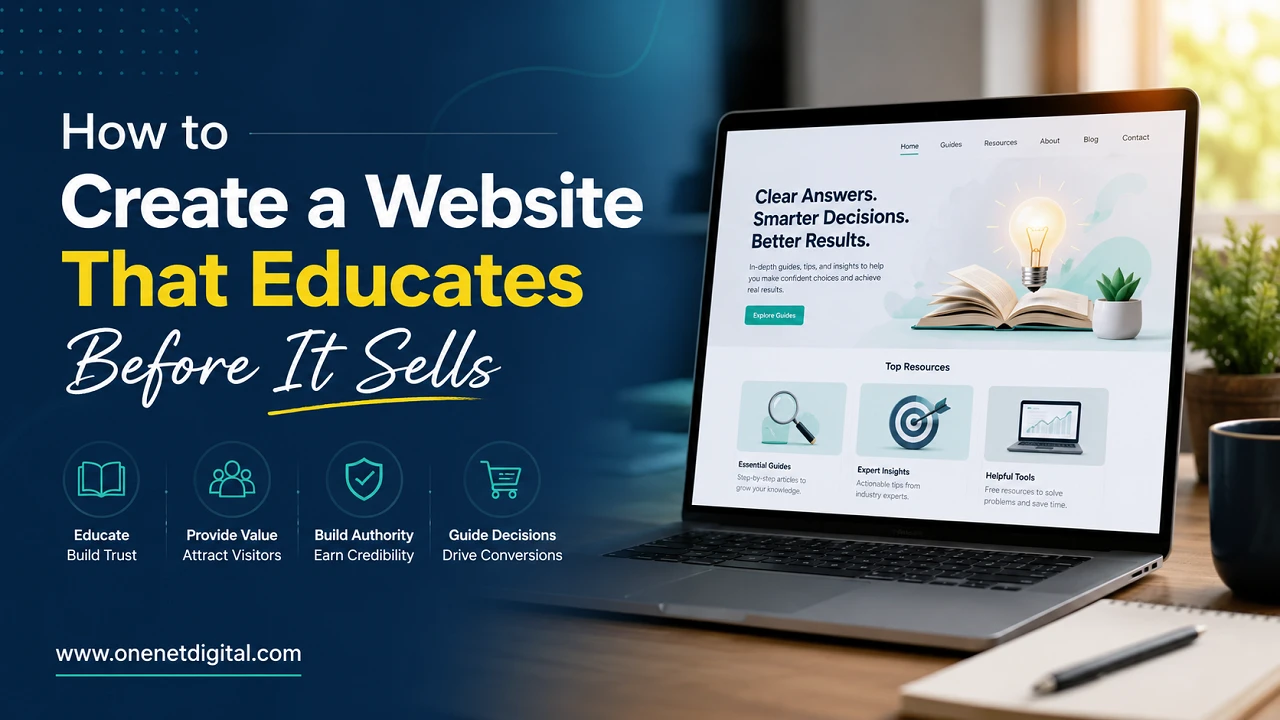
Educate Before You Sell Educating is providing visitors with useful, relevant and easy-to-digest information before you ask them to buy or contact your business. Instead of plastering every page with self-promotion, your website should focus on answering common questions, explaining important concepts, and helping users solve real problems. This gives visitors the opportunity to make choices at their own speed.
Your website can educate your audience in a variety of ways. You can publish beginner guides, step-by-step tutorials, FAQs, industry insights, product comparisons, useful blog articles, buying guides, and case studies. When you consistently provide valuable information to your visitors, they start to trust your expertise and are more likely to return when they’re ready to make a product or service choice.
Why Educational Websites Perform Better
Most people do their research before buying. They will look at options, read articles and search for reliable sources to answer questions. A website that is based on education to the visitors creates a good experience and helps the users to feel more confident in the process.
Educational websites have several long-term benefits as well. Helpful content builds trust with visitors, improves user engagement, increases repeat visits, encourages people to spend more time on the site and supports better search engine rankings. They don’t push a hard sell, they provide value first, which naturally creates qualified leads.
Understand Your Audience First
Before you start creating content, you need to understand who your visitors are and what they need. Each audience has different goals, challenges, and expectations, so knowing them helps you create content that is relevant and useful.
Consider the problems your audience is trying to solve, the information they are looking for, the questions they ask most often, and the concerns that might prevent them from making a decision. Knowing your audience allows you to create educational content that benefits your audience instead of being a mere promotion for your business.
Also Read: How to Turn Website Visitors into Repeat Visitors (2026 Guide)
Create Helpful and Informative Content
A good education website is based on quality content that really benefits its visitors. Rather than constantly talking about your products or services, write articles that address common questions and provide practical solutions.
How-to guides Beginner tutorials Industry trends Common mistakes to avoid best practices Glossaries Checklists Resource Pages Useful content can be anything from… Over time, a library of informative content makes your website a trusted source of information and encourages visitors to return when they need answers.
Write in Simple Language
One of the easiest ways to improve the user experience is to write in plain English. If a visitor is new to a topic, he/she should not be intimidated at any point by complex terms or technical language.
Use short sentences. Organize your content with headings. Keep paragraphs easy to scan. Explain complex ideas in a straightforward manner. Writing in plain language allows you to reach a wider audience, and helps visitors quickly understand the information they came to find.
Organize Information Clearly
Even the most valuable content is worthless if visitors can’t find it. A website that is well organized will help users move between pages and find other resources without getting lost.
Your website should have: intuitive navigation menus, logical page layouts, category pages, search capabilities, and internal links to related content. Structured information keeps visitors on your site longer, exploring your content instead of leaving after the first page.
Use Visual Content to Explain Concepts
Some topics cannot be adequately expressed in writing alone. Information is often easier to understand with visual elements, especially when describing processes, comparisons or technical concepts.
Use infographics, diagrams, charts, screenshots, videos and process illustrations all over your site. These visual resources allow to simplify complex information, make it easier to read and help the visitors to remember the key points more easily, keeping them engaged for longer.
Also Read: Why Website Clarity Is More Important Than Creativity
Include Real Examples
Examples make educational content more practical by showing how a concept works in real-world situations. Instead of merely explaining ideas theoretically, use real-world examples that allow readers to connect with the material.
For example, when talking about website design, you can mention how better navigation can help visitors find important pages faster. Practical examples make your content more relatable and build credibility and help readers understand the value of your recommendations better.
Avoid Overly Promotional Language
Businesses make a huge mistake when they treat every page as a sales pitch. Visitors are usually able to spot overly promotional content, and it can erode trust rather than build it.
Instead of hyperbole, like “We are the best company for all your needs”, try to give balanced information. For example, say that the right solution depends on factors such as goals, budget and specific requirements. The purpose of educational content is to aid people in making informed decisions, not to sell.
Build Trust Through Transparency
Any successful website needs to be trusted. Visitors are more likely to engage with businesses that are honest in their communications and provide accurate information without making unrealistic promises.
Make your website easy to understand, up-to-date, factual, and include actual customer experiences when available. Transparency about what you sell, the services you provide or your processes will make visitors feel more confident and this will reinforce your credibility over time.
Add Internal Links to Related Topics
Many educational websites have a number of articles on similar topics. Internal links help visitors continue learning with relevant content without having to search again.
For example, an article about website design can easily link to issues like user experience, SEO, website speed, or mobile responsiveness. Internal linking also helps search engines understand the relationship between your pages, which can help support better SEO performance, in addition to aiding navigation.
Also Read: How to Measure Content Quality Beyond Google Rankings
Optimize Content for Search Engines
Creating helpful content is just half the battle. Your pages can be optimized for search engines to improve people’s ability to find your educational resources through organic search results.
Incorporate your primary keyword naturally, craft descriptive headings, employ distinct title tags and meta descriptions, optimize images with alt text, include pertinent internal links, and maintain concise paragraphs. These are fundamental SEO best practices. Good SEO should never make the content feel repetitive. It should always increase readability and user experience.
Keep Your Content Updated
As industries and technology advance and as user expectations change, educational content needs to be accurate. “Outdated information can erode trust and make your website less useful to visitors.
Regularly review your articles for updating facts, improving examples, refreshing statistics when appropriate and adding current best practices. Keep your content fresh, so that your visitors will continue to receive reliable information, but also so that they will return for the latest insights.
Encourage Learning Before Action
It’s totally normal to have visitors who aren’t ready to buy right now. Help users on a learning journey that builds their confidence, instead of pushing for immediate conversions.
A visitor could start with a beginner guide, read related articles, compare different solutions and slowly understand which solution fits their needs best. This educational approach respects the user’s decision-making process and often results in more informed and higher quality questions.
Measure How Visitors Interact with Your Content
By monitoring user behavior, you can learn what content offers the most value and where improvements can be made. Analytics can tell you how visitors are interacting with your learning materials and help you find ways to improve the experience as a whole.
Useful metrics are average time on pages, bounce rate, pages per session, returning visitors, scroll depth and most popular blog posts. Regularly examining these insights will allow you to adjust your content strategy and continue producing resources that serve the purpose of educating your audience well.
Also Read: Why Every Website Needs a Content Maintenance Strategy
Conclusion
One of the best ways to establish trust with your audience is to have a website that educates before it sells. Instead of focusing on conversions, an educational website helps visitors understand their challenges, explore solutions, and make informed decisions at their own pace.
By creating useful content, answering frequently asked questions, structuring information clearly, keeping language simple, and implementing SEO best practices, you can build a website that offers genuine value. In the long run, this approach will not only improve the user experience but will also result in repeat visits, boost credibility, and foster sustainable business growth without being overtly promotional.
Frequently Asked Questions (FAQs)
1. What does it mean to create a website that educates before it sells?
A website that educates before it sells focuses on providing valuable information to visitors before encouraging them to make a purchase or contact the business. It answers common questions, shares useful resources, and helps users make informed decisions.
2. Why is educational content important for a website?
Educational content helps build trust, improves user engagement, increases the time visitors spend on your website, and encourages them to return for more information. It also supports better search engine visibility by offering valuable content.
3. What type of content can educate website visitors?
You can educate visitors through blog articles, beginner guides, tutorials, FAQs, buying guides, case studies, industry insights, product comparisons, checklists, and other informative resources that solve their problems or answer their questions.
4. How does educating visitors help increase conversions?
When visitors understand their options and trust the information provided, they are more likely to feel confident about taking the next step. Educating users first often results in higher-quality leads and better long-term conversions.
5. Should every page on my website include promotional content?
No. While promotional content has its place, every page doesn’t need to focus on selling. Informative and educational pages help build credibility and create a better user experience, making visitors more likely to engage with your business later.