
Introduction
It’s great to publish content and see it rank on search engines, but rankings don’t tell the whole story. A page can show up on the first page of search results, but it might not be engaging readers, generating leads, or building trust. On the other hand, some posts that are not ranked at the very top can consistently drive qualified traffic, encourage conversions and support long-term business goals.
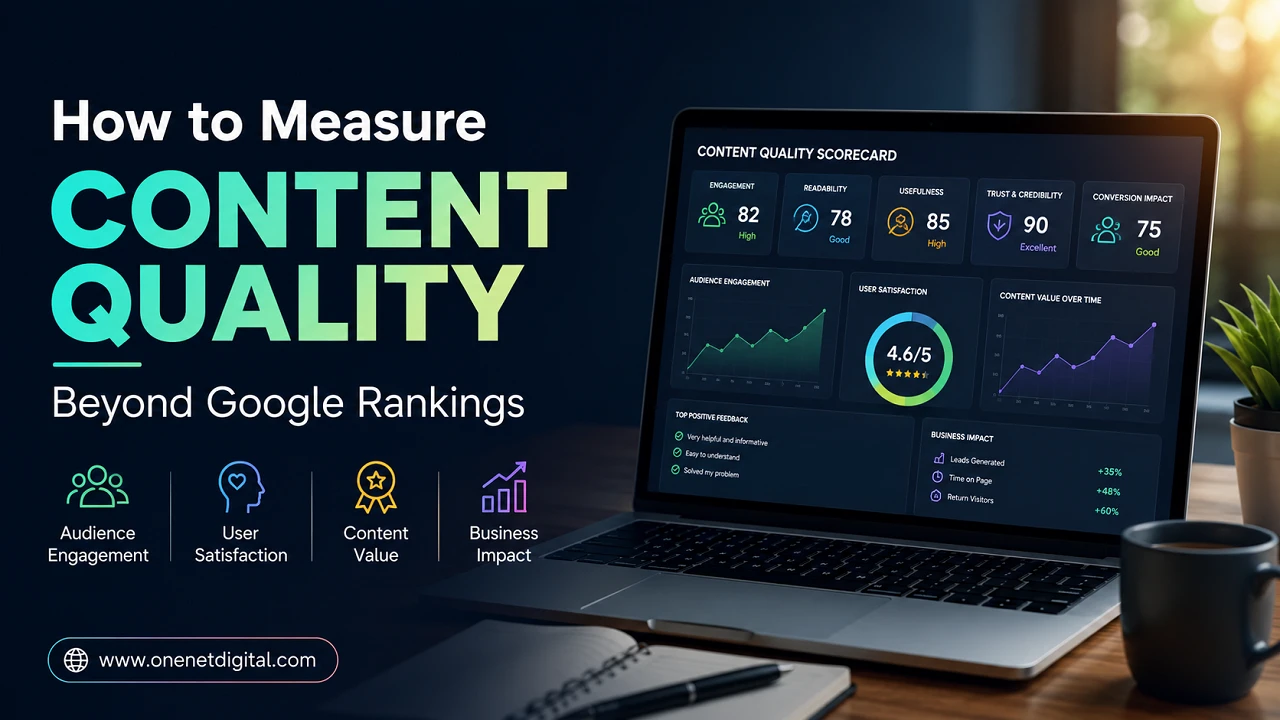
Measuring content quality is about how users interact with your content, not just looking at search engine positions. Engagement, readability, conversions, trust and overall user experience paint a much clearer picture of content success over time. Monitoring these alongside SEO metrics enables businesses to create content that ranks well for both users and search engines.
In this guide, we’ll cover how to evaluate content quality beyond search rankings, what metrics are most important, and how to continually improve your content for both users and search engines.
Why Rankings Aren’t the Only Measure of Success
Google rankings matter as they impact visibility and organic traffic but they are one dimension of content performance. Search results are always fluctuating as Google updates its algorithms, competitors improve their content, and user intent changes over time. That means even high-quality content can see temporary ranking shifts without losing its usefulness or credibility.
Likewise, if you’re first on the list for a keyword, don’t think visitors are finding your content useful. Strong rankings don’t offer much business value when users bounce quickly, don’t engage with the information, or don’t do anything meaningful.
High quality content should answer users’ questions clearly, provide accurate and reliable information, attract the reader’s attention, encourage the reader to explore the website further, and support wider business objectives. And it needs to be kept up to date as information changes over time. Website owners should not only check keyword positions but also how well their content satisfies users’ expectations and helps them to achieve long-term goals.
User Engagement Shows Whether Readers Find Value
User engagement is a very reliable indicator of content quality. As visitors arrive on your pages, analytics tools can help you track how they interact. If readers spend a few minutes in an article, scroll through most of it, click on other pages, or revisit the website later, that behaviour signals that the content is useful and relevant.
Metrics such as average engagement time, time on page, pages viewed per session, scroll depth, and returning visitors, when looked at together, offer valuable insight into how well your content meets user needs. If, however, visitors consistently leave within a few seconds, it may mean the content doesn’t meet their expectations, doesn’t answer their questions or is difficult to read.
High engagement is, in general, a good sign that people trust the information they’re being presented with and are willing to keep exploring your website, so it’s a much more meaningful measure of quality than rankings alone.
Also Read: Why Every Website Needs a Content Maintenance Strategy
Understand Bounce Rate in the Right Context
Bounce rate is a misunderstood metric. A high bounce rate is not always a bad thing. For example, if someone searches for a simple factual question and immediately finds the correct answer, they may leave the page without visiting another. In that case, even though there was a bounce, the content did meet the user’s intent.
Bounce rate is more valuable when considered alongside other engagement metrics. A high bounce rate and very short engagement time on a long educational article or a comprehensive guide could signal problems such as a weak introduction, slow loading pages, poor formatting, irrelevant information or content that does not meet search intent.
Don’t view bounce rate as a standalone metric. Consider it alongside engagement time, scroll depth, and user behavior to determine if users are genuinely engaging with your content.
Scroll Depth Reveals How Much Content People Actually Read
Publishing long-form content is only useful if people are reading it. Scroll depth tracking is a way of knowing how far down a page people scroll, before they leave. If most people stop reading halfway through a long article, it could be an indication of opportunities to improve the structure and readability.
Short introductions, descriptive headings, concise paragraphs, bullet points, relevant visuals and removing redundant information can dramatically improve content consumption. Well-structured articles will also naturally encourage the reader to keep scrolling as the information is easier to digest.
Monitoring scroll behavior helps you find sections where users stop reading a lot, so you can improve those areas and have a better reading experience.
Internal Link Clicks Show Reader Interest
When the content is useful, visitors naturally want to keep learning. Tracking clicks on internal links can also help you see if your readers are digging into related blog posts, service pages, case studies, product details, or other resources.
Internal linking helps site navigation, and increases overall engagement. Clicking through to related content on a regular basis shows that people trust your information and are interested in learning more. It is a win-win for user experience and site performance.
Also Read: How to Create Content That Supports User Intent Instead of Keywords
Social Shares and Reader Feedback Offer Valuable Insights
Social shares aren’t a direct Google ranking factor, but they do show audience interest and can help get your content in front of new audiences outside of search engines. Articles with useful data, practical advice, compelling stories or original perspectives are more likely to be shared across social platforms.
Direct feedback from readers also gives insights that analytics cannot fully capture. Blog comments, emails, responses via contact forms, surveys and community discussions all point to what readers found helpful and what information may still be missing. You can find opportunities for future updates by simply asking questions like whether the article solved their problem or what could be improved.
Improve Readability and Keep Content Updated
More readable content keeps users on your site longer and helps them absorb more information. Simple improvements like short paragraphs, descriptive headings, logical organization, bullet points and plain language help articles to be better understood by a wider audience. An exception is writing for highly specialized professionals; avoiding unnecessary technical jargon improves accessibility and user satisfaction.
Also, regular content updates are important. Statistics will become old, examples will become irrelevant, screenshots will change and links can break over time. Periodically reviewing published content helps ensure that information is accurate, trustworthy, and in line with current industry developments. Adding fresh content to older articles often provides greater long-term value than constantly creating new content.
Don’t Ignore Technical Performance
Good writing can’t compensate for a bad user experience. If your pages load slowly, are confusingly laid out, are not mobile responsive, have broken formatting or are difficult to navigate, visitors may leave before they even get to interact with your content.
Regularly audit technical elements like page speed, mobile optimization, secure HTTPS links, accessibility, and proper formatting. A well-designed website allows readers to concentrate on the information, without struggling with usability problems.
Compare Your Content with Competitors
The quality of the content is always relative to the alternatives. Examining competing pages on the same topic reveals opportunities for improvement. Does your article have more complete information, explain concepts more clearly, have more recent examples, use effective visuals, or answer additional questions that users may have.
The goal is not to clone what competitors are doing but rather to develop a more complete, accurate and user-friendly resource that better addresses the needs of search intent.
Also Read: Why Content Depth is More Important Than Content Length
Best Practices for Maintaining High-Quality Content
Quality content is not the result of a single optimization or publication. It needs to be constantly reviewed, updated, and refined based on user behavior and evolving information. Priorities providing clear, well-structured, easy-to-read answers to authentic user questions with accurate information. Refresh articles with new statistics, examples and recommendations. Make them easier to read with headings, visuals and logical organization.
Track engagement, conversions, user feedback and technical performance alongside search rankings to get the complete picture of how your content is performing. Update old posts that still get traffic instead of posting a lot of new content.
At the end of the day, the best content is measured not only by its ranking, but by how well it helps readers, builds trust, fosters engagement and supports long-term business goals. Stronger search performance is often the natural result over time when usefulness, clarity, credibility and user experience take center stage.
Conclusion
Google rankings are a key indicator of visibility, but they’re only one part of content success. Content that is truly valuable educates the reader, engages the reader, motivates the reader to take some sort of meaningful action and that continues to provide value over time.
Measure engagement time, conversions, scroll depth, returning visitors, backlinks, and user feedback to gain insights into the effectiveness of your content. These insights, combined with frequent updates and a high focus on user intent, aid you in creating content that performs well with audiences and search engines over the long term.
FAQs
1. Why shouldn’t I measure content quality only by Google rankings?
Google rankings can change due to algorithm updates, competition, or shifts in search intent. Content quality is better measured by how users engage with your content, whether it answers their questions, and if it supports your business goals.
2. What are the best metrics for evaluating content quality?
Some of the most useful content quality metrics include engagement time, scroll depth, click-through rate (CTR), conversion rate, returning visitors, internal link clicks, natural backlinks, and user feedback.
3. Does a high bounce rate always indicate poor content?
No. A high bounce rate isn’t always a negative signal. If users quickly find the information they need and leave satisfied, the content may still be successful. Bounce rate should always be analyzed alongside engagement time and other user behavior metrics.
4. How does engagement time reflect content quality?
Longer engagement time generally indicates that visitors are reading and interacting with your content. It suggests the information is relevant, useful, and aligned with user expectations.
5. Why is scroll depth important?
Scroll depth shows how much of your content users actually read. If most visitors stop reading early, it may indicate the need for better formatting, shorter introductions, or more engaging content.