Introduction
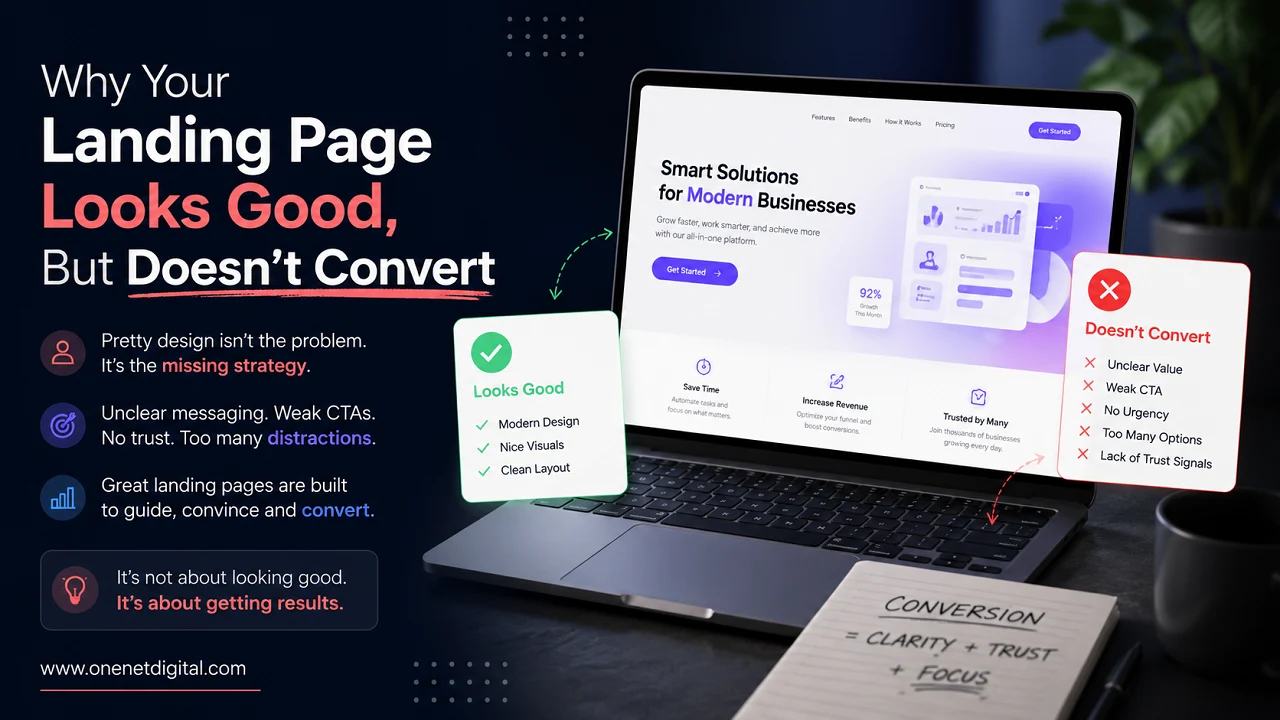
Creating visually appealing landing pages can be a time-consuming and expensive process for many businesses. They use modern design, beautiful images, animations, and professional layouts, hoping that visitors will convert automatically. But many landing pages don’t generate leads, enquiries or sales even when they get traffic. This is one of the most common problems in digital marketing today.
Good design isn’t enough to increase conversions in 2026. Even if a landing page looks modern and has a visually stunning design, if it does not properly guide users or clearly solve their problems, visitors usually leave without taking any action.
Many companies focus too much on appearance and neglect user psychology, clarity, trust, and user experience. This gets you the look of a professional page, but performance in terms of actual conversions is poor.
Search engines like Google also care about engagement signals. When visitors click a page and bounce quickly without engaging, it can negatively impact SEO performance and conversions down the line.
The good news is that most landing page conversion problems can be fixed without a complete redesign. Small tweaks to messaging, structure, readability, and trust building often produce much bigger results.
A Good-Looking Page Isn’t Always a Clear Page
A huge mistake many businesses make is prioritizing visual design over clarity.
Many landing pages look good but don’t communicate simple information well. Visitors open the page and are immediately confused about:
- What the business provides
- Who the service is aimed at
- Why this is important
- What are the next steps for them
People don’t spend much time trying to figure things out. If they don’t get the message within the first few seconds, people will usually just leave the page.
A landing page should quickly outline the problem, the solution, and the value you’re providing. Clarity nearly always converts better than visual complexity.
Simple, focused landing pages tend to do a lot better because the user immediately understands what the page is about.
Also Read: How Website Fonts Affect Customer Trust and Readability
Weak Headlines Hurt Conversion Rates
The headline is one of the biggest elements of any landing page. There are a lot of companies that use generic headlines that sound professional but don’t spark interest or clearly explain value. Visitors should immediately see why the page is relevant to them. A poor headline will cause users to lose interest before they even scroll down further.
Strong landing page headlines tend to focus on:
- Solving a problem
- Highlighting benefits
- Creating curiosity
- Clearly communicating value
People don’t convert because a page looks pretty. They convert because the message quickly and naturally connects to their needs. Even small tweaks to headlines can really boost landing page performance.
Visitors Fall into Too Much Information
Another common cause of landing page failure is too much information. Some pages attempt to explain everything at once. Visitors get frustrated from large blocks of text, too many sections, too many visuals, and endless explanations.
Users tend to stop reading and bounce when they get overwhelmed. Landing pages should be focused and easy to consume. Visitors should be able to move from one section to another without any confusion.
Simple readability improvements like shorter paragraphs, cleaner spacing, and better content flow can significantly boost engagement. Sometimes less is more. If you remove unnecessary information, you will increase conversions.
Lack of Trust Keeps People from Taking Action
Conversion optimization is heavily dependent on trust. A landing page can look great, but if it appears untrustworthy or too salesy, users will still hesitate.
Many landing pages fail because they don’t have real elements to build trust. Visitors want proof before they share personal information or make buying decisions.
Trust can be improved by:
- Testimonials
- Real business information
- Customer reviews
- Clear contact details
- Secure website experience
When a business feels authentic and transparent, users convert at a much higher rate. In 2026, customer trust has become one of the most important parts of landing page optimization.
Also Read: Why Your Website Isn’t Getting Scrolled
The Call-to-Action Is Frequently Weak or Confused
The landing page should help the user toward a single clear action. But many businesses use weak call-to-action buttons or confuse visitors with too many choices.
For example, some pages invite users to:
- Contact now
- Subscribe
- Download
- Explore services
- Follow social media
All on the same boat. Too many choices reduce focus and hurt conversions. A strong landing page usually has one primary action. Users should immediately know what they are supposed to do next. The call to action must be natural, visible, and relevant to the user’s intent.
Bad Mobile Experience Reduces Conversions
Now, smartphones are the main source of landing page traffic. A landing page can look great on desktop but still perform poorly on mobile. Frustration builds quickly with small text, poor spacing, slow loading, and broken layouts.
Mobile users want fast and fluid experiences. If it’s hard to navigate the page, visitors leave without converting. Google also uses mobile-first indexing, so poor mobile usability can affect both SEO and user engagement.
To ensure that the experience feels clean and comfortable, it is recommended to regularly test landing pages on various mobile devices.
Slows Load Time, Damages User Experience
Landing page speed has a direct impact on conversions. If the page takes too long to load, many users will leave the page without even seeing the content. Slow speed immediately creates frustration and reduces trust.
Slow landing pages are usually caused by:
- Heavy images
- Too many animations
- Video backgrounds
- Large scripts
- Poor hosting quality
Businesses tend to add too many things, visually thinking it is improving the design, but these things tend to hurt performance instead.
Fast-loading landing pages usually get:
- Better engagement
- Higher conversion rates
- Lower bounce rates
- Improved user experience
Speed optimization is a huge part of conversion optimization in 2026.
Landing Pages Often Focus Too Much on the Business
Too many landing pages spend too much time talking about the company and not the problems of the customer.
Visitors primarily interested in:
- How the product is helpful to them
- What problem is solved
- Why they should trust the service
- What results can they expect
Users don’t want long self-promotional paragraphs telling them as soon as they land on the page. Customer/solution-centric landing pages generally convert far better than company-centric pages.
Also Read: How AI Chatbots Are Changing Small Business Customer Support
Poor Content Structure Reduces Engagement
Good information can be weakened if the structure of the content is hard to understand. Pages with large blocks of text, inconsistent headings, and poor visual flow look like a lot of work to read.
Users should be able to scan the page easily and get the key points quickly. A clean structure keeps visitors engaged for longer, and naturally increases the chances of conversion.
Good content structure enhances:
- Readability
- Scroll depth
- User experience
- Conversion performance
That’s why layout and readability are just as important as design quality.
Too Many Design Effects Overwhelm
Some businesses clutter landing pages with animations, sliders, popups, and moving graphics to make the page feel modern. But too many effects often distract from focus, rather than enhancing engagement. Most users prefer a simple, distraction-free experience where they can focus on the message clearly.
Modern landing page optimization is trending more and more toward cleaner, minimalist designs, as they improve readability and usability. Visually balanced landing pages perform much better than overly complicated ones.
Sometimes User Intent Ignored
Landing pages are a failure if they don’t match user intent — and that’s one of the main reasons why. If someone clicks an ad looking for pricing info and lands on a page filled with generic marketing copy, frustration can mount quickly.
Landing pages should align closely with:
- Search intent
- Ad messaging
- User expectations
- Customer goals
The more relevant the experience feels, the greater the chances of conversion. Businesses that understand user intent tend to create much more effective landing pages.
Summary
Many landing pages don’t convert because they look bad, but because they prioritize design over clarity, trust, readability, and user experience. Landing pages should be simple, fast, helpful, and trustworthy for users by 2026. A pretty-looking page no longer cuts it when it comes to getting conversions.
Small things such as messaging, mobile usability, page speed, trust signals, and content structure can all contribute to landing page performance without a complete redesign. Over time, businesses that solve customer problems clearly and create smooth user experiences tend to have much better conversion results.
The best landing pages aren’t always the flashiest ones — they’re the ones that help visitors make decisions.
FAQs
1. Why does my landing page look good but not convert?
Perhaps your landing page is not trustworthy, confusing, or it doesn’t have a strong message or a good user experience.
2. Does landing page speed impact conversion?
Yes, slow-loading landing pages can lead to higher bounce rates and lower conversion rates.
3. Why is landing page mobile optimization important?
Poor mobile usability can rapidly reduce engagement, as most users browse on their smartphones.
4. Can too much information reduce conversions?
Yes, too much content can overwhelm visitors, leading to confusion and lower conversion rates.
5. What makes a landing page convert better?
Usually, clear messaging, strong trust signals, fast loading speed, and simple user experience improve conversions.