
Introduction
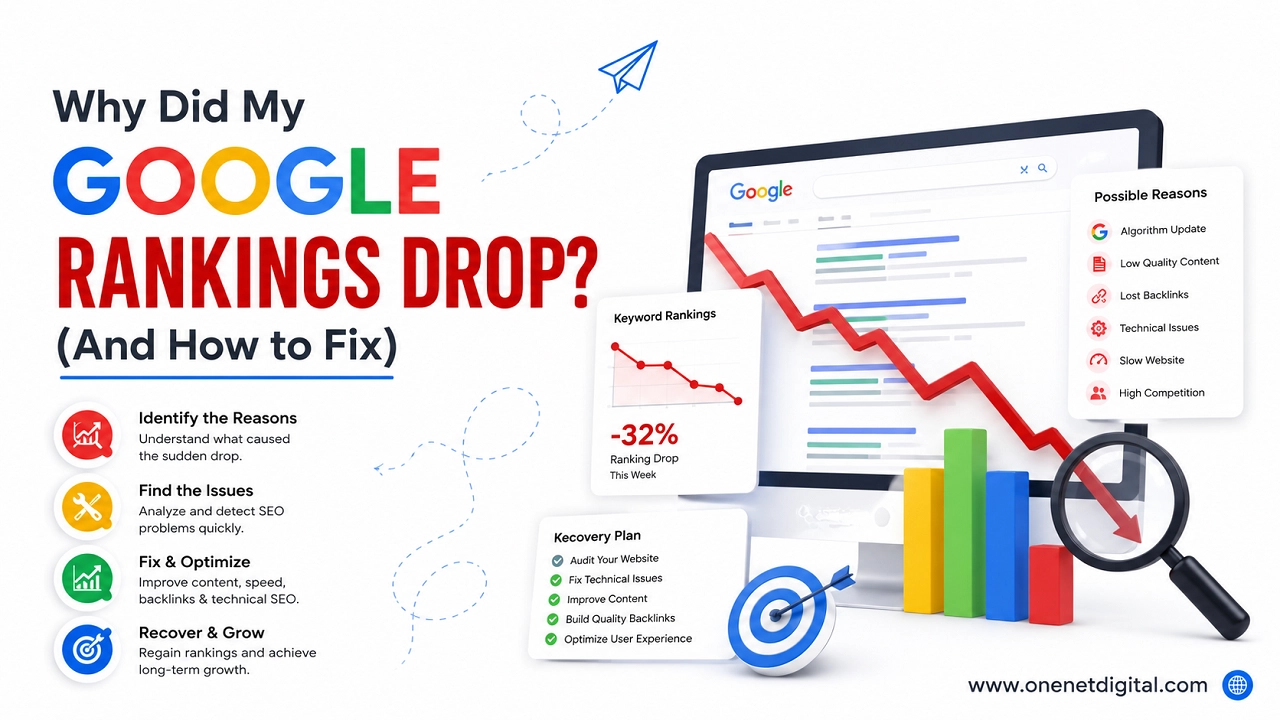
Many businesses see their Google rankings suddenly plummet at some point. One day, the website is getting good traffic, and suddenly the rankings start falling for no apparent reason. This could be a stressful time, especially for businesses that rely heavily on organic traffic and online leads.
The truth is that SEO ranking drops are common. Search engines such as Google are constantly updating their algorithms to improve search quality and the user experience. This can sometimes lead to loss of rankings for websites if certain SEO issues arise.
The good news is that ranking drops are often fixable. Businesses need to identify the possible reasons for the problem and then gradually improve their website.
In this article, we will understand why Google rankings suddenly fall and how businesses can regain their SEO performance.
Google Algorithm Updates May Impact Rankings
Google algorithm updates are one of the biggest reasons behind the ranking drops. Google frequently updates its search algorithm to enhance search results for users. The updates are as follows:
- Quality of content
- User experience
- Speed of Website
- How to Stop Spam
- Mobile performances
Websites can lose rankings after an update because competitors are providing better content or a better user experience. That doesn’t necessarily mean the website is bad. It just means that improvements are needed to meet today’s SEO standards.
Businesses need to keep an eye on SEO trends and update their website content on a regular basis.
Low-Quality Content is Bad for SEO
Content is a big part of search engine rankings. A website that contains thin, stale, duplicate, or low-value content can slowly lose rankings over time.
Google is very focused on useful user-focused content now. Sites that simply publish content for keywords and don’t solve user problems often have a hard time staying ranked.
Businesses should create content in the following categories:
- Useful
- It is easy to read.
- Periodic updates
- Related to user intent
One of the best ways to recover rankings naturally is to improve the quality of your content.
Also Read: How to Fix a Slow Website Without Changing Your Design
Website Speed Problems Hurt Rankings
Slow websites result in a bad user experience, which can affect SEO. If people are bouncing quickly because pages take forever to load, search engines may decide the website is less useful.
Typical speed problems are:
- Big pictures
- Bad hosting
- Too many plug-ins
- Not optimized code
Fast websites tend to perform better in rankings and conversions. By optimizing your website speed and conducting regular speed tests, you can achieve more stable SEO.
Mobile Experience Might Be Poor
Most online searches are now done on mobile devices. If a website does not work well on smartphones, rankings can drop. Google uses mobile-first indexing, meaning it mostly relies on the mobile version of websites for ranking.
Bad mobile experience usually includes:
- Loading is slow
- Broken layouts
- Text that is difficult to read
- Annoying navigation
Websites can recover traffic and engagement by improving mobile usability.
Technical SEO Problems Can Cause Rankings to Fall
Another common reason for sudden ranking drops is technical SEO problems. Occasionally, companies unwittingly cause issues when they update or redesign their websites.
Technical SEO issues might include:
- Pages removed
- Indexing mistakes
- Metatags are missing
- Redirect issues
- Redundant content.
Small technical errors can have a big impact on rankings. Regular SEO audits help to find and fix these problems before they become serious.
Also Read: How to Make Your Website Look More Professional and Trustworthy
Lost Backlinks Can Decrease Authority
Backlinks are still an important ranking factor in SEO. Loss of quality backlinks can result in a drop in rankings because search engines see less authority and trust.
Backlinks can disappear if:
- Other websites take down links.
- Pages are removed
- Website URLs change.
- Competitors forge closer links.
Businesses should regularly check their backlink profiles and focus on naturally earning quality backlinks through great content and a strong online presence.
Competitors May Be Upgrading Faster
Sometimes you get ranked lower, not because your website got worse, but because your competitors got better faster.
Competitors might:
- Publish more quality content.
- Enhance website speed
- Develop better backlinks
- Focus on more effective keywords.
SEO is very competitive in 2026. Maintaining a good ranking requires continuous improvement by businesses. Doing competitor analysis regularly helps a business to know what changes to make.
Keyword Intent Could Have Changed
Search intent is fluid. Google is constantly working to understand what people are really searching for when they type in certain keywords.
For example, if users are now looking for video content or detailed guides for a keyword, sites with outdated or shallow content could lose rankings.
Older content needs to be refreshed regularly to remain aligned with current search intent and user expectations.
Over-Optimization Can Cause Problems
A lot of websites get de-ranked because they overemphasize SEO tricks but neglect user experience.
Issues such as:
- Keyword Stuffing –
- Links that are spammy
- The text hidden
- Keyword stuffing Hack #1
- can damage SEO rankings.
Today, SEO is more about natural content and real value for users. In the long run, businesses need to avoid aggressive SEO techniques and focus on quality improvements.
Also Read: Why Your Website Gets Traffic but No Customers (And How to Fix It)
Website Downtime Can Impact Rankings
Rankings can drop if a website is frequently offline or has server issues. If a site can’t be crawled by search engines, it may be unavailable.
Frequent downtime creates a bad user experience, impacting trust and engagement. Proper website maintenance and reliable hosting will help to prevent these issues.
Old Content Can Damage Rankings
Without regular refreshes, old content can slowly drop in rankings. Search engines love new and relevant content, especially for competitive topics.
Businesses should do the following on a regular basis:
- Blog posts update
- Upgrade statistics
- Add new info
- Refresh legacy SEO content.
Websites often regain lost rankings faster with content updates.
How to Get Back Your Google Rankings
Rankings take time to come back, but can be done with the right approach. Businesses should concentrate on:
- Enhancing Content Quality
- Technical SEO issues to fix
- Optimizing website loading speed
- Revising old pages
- Enhanced mobile experience
- Creating Quality Backlink
SEO recovery is a long haul, not a sprint. Steady progress results in better long-term outcomes. SEO recovery requires a lot of patience.
User Experience First
Improving user experience is one of the best SEO strategies in 2026. Google wants to rank sites that are helpful to users.
Businesses should consider:
- Useful content
- Easy navigation
- Loads quickly
- Mobile-friendly layout
- Reliable information
Sites that put users first are more likely to rank higher in search results over time.
Summary
Sudden Google ranking drops can happen for many reasons, including algorithm updates, weak content, technical issues, poor speed, or increased competition. The good news is that most SEO problems can be corrected with proper analysis and ongoing improvement.
Instead of searching for quick tricks, businesses should concentrate on high-quality content, improving user experience, and maintaining strong technical SEO. In 2026, websites that offer real value and better experiences are more likely to recover rankings and achieve long-term SEO success.
Frequently Asked Questions
1. Why did my Google rankings fall so quickly?
Ranking decreases can be caused by algorithm updates, technical SEO issues, bad content, or increased competition.
2. Will rankings bounce back after a Google update?
Yes, it is possible for websites to regain rankings after enhancing content quality, SEO, and user experience.
3. Does website speed impact Google rankings?
Yes, slow websites can be bad for SEO and user engagement.
4. How much time does SEO recovery take?
SEO recovery can take weeks or months, depending on the issue and level of competition.
5. What’s the best way to keep up your rankings?
Maintaining rankings takes regular content updates, strong technical SEO, fast website speed, and quality user experience.