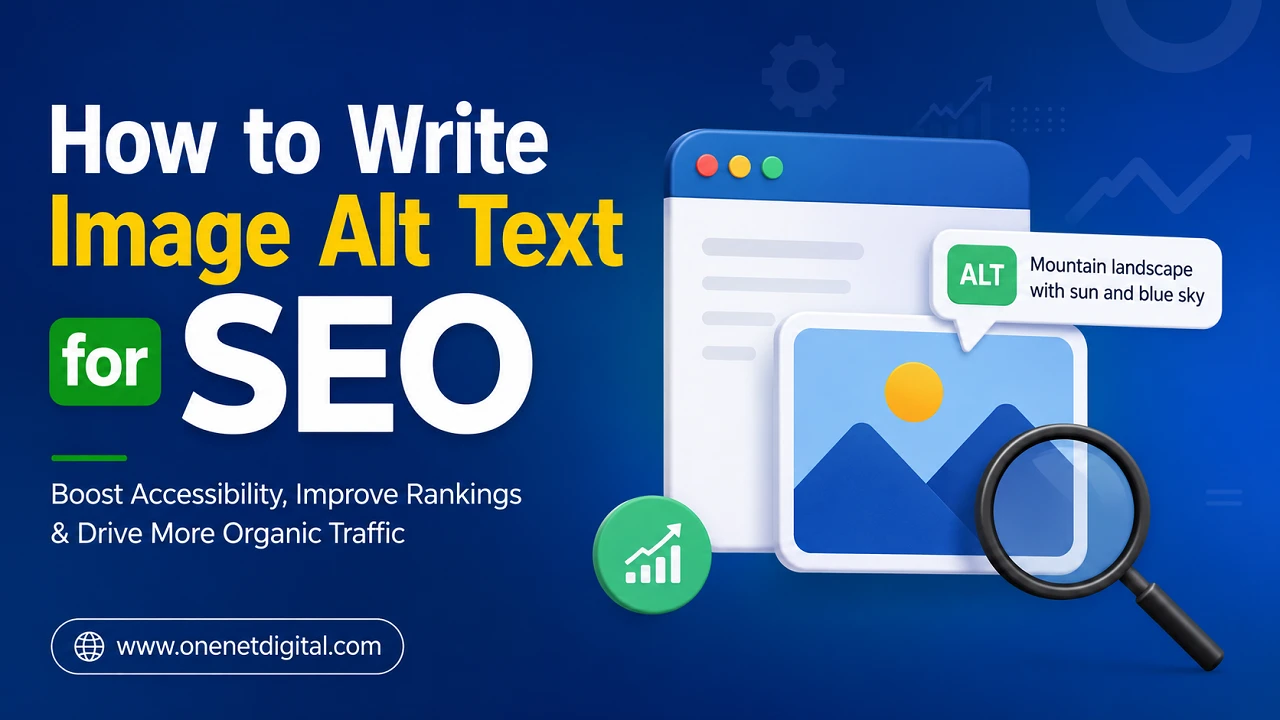
Web pages are more attractive and easier to read with pictures. They help clarify ideas, break up long pieces of text and make the whole thing easier to read. But without any extra information, search engines can’t fully understand what’s in an image. That’s where image alt text comes in handy. It contains a short description of an image so search engines and screen readers can understand its purpose.
Good alt text is written well for search engine optimisation and website accessibility. This helps search engines categorise images better and also helps people with visual impairments access visual content using screen readers. Alt text should be a natural description of the image, not a place to put keywords.
What is Image Alt Text?
Image alt text is a written description of an image that is added to an image in a webpage’s HTML. It is also known as alternative text. Alt text shows up if an image doesn’t load due to slow internet connection or technical problem. Screen readers also read this text out to describe images for users who cannot see them.
Search engines use image descriptions to understand what an image contains because they are not able to “see” images as humans can. A good description helps to connect the image to the surrounding content and increases the chance that the image will show up in image search results.
Good alt text describes the image clearly and does not add unnecessary information or unrelated words.
Importance of Alt Text
Alt text is important for the improvement of a website. It provides search engines with additional context about images so they can better understand the overall theme of a page. It helps with the visibility of images in the search results and brings additional organic traffic.
Another massive plus is accessibility. Many people surf the internet using screen readers. Images may contain valuable information that is not in meaningful descriptions. Clear alt text makes it easier for every visitor to understand content.
Furthermore, it enhances user satisfaction when the image fails to load, helping visitors understand what the missing image was intended to show.
Also Read: How to Write Better SEO Titles Without Clickbait
Describe the picture in simple language
The main purpose of alt text is to describe what is in an image. This is a simple, straightforward and easy to understand description. Don’t try to describe everything. Just concentrate on the most important thing in the picture.
For instance, if the photo shows someone creating website content on a laptop, the caption should reflect that activity, rather than using generic terms like “picture” or “graphic.”
Accurate descriptions help search engines understand the image and can provide users with useful information if they are unable to view the image.
Keep Natural Descriptions
Alt text should be written like a normal sentence, not a keyword list. It must be related to the page topic and offer real value.
Many website owners make the error of putting the same keywords over and over in every image description. This results in unnatural text that is hard to read and offers little benefit. Instead, write descriptions as you would describe an image to someone else.
Natural language also improves readability and is more accessible to users who rely on screen readers.
Keep it Short and Simple
Alt text is best when it is brief but meaningful. In most cases a short sentence will be enough to describe the image.
Long descriptions can be off-putting to users and make screen readers less useful. In contrast, very short descriptions often do not provide enough context.
A balanced description creates a picture of the image, with no extra detail. Provide information that helps users understand why the image is on the page.
Also Read: How to Write More Effective Meta Descriptions to Increase Clicks
Make sure the text around the picture fits
All images should reinforce the topic at hand. The description should also be connected to the surrounding text.
For example, if an article is about website speed optimisation, an image of compressed image files should have a description that is relevant to image optimisation, not an unrelated description.
Search engines examine the image description and the content around the image to understand the page. When they do naturally match, the page is easier for readers to interpret and more useful.
Eliminate Common Mistakes
One common mistake is to leave the alt text blank for important images. Search engines get less information without a description, and screen reader users miss valuable content.
Another mistake is describing more than one image in the same way. Each photo is to be considered unique with its own special explanation.
A lot of times they start their descriptions with something like “image of” or “picture of. Screen readers already know what images are, so the words usually add no value. It is better to begin directly with the description.
Another tactic to stay away from is keyword stuffing. Repeating the same terms over and over again makes the description sound unnatural and less helpful.
Write a Unique Description for Each Image
Every image on a page should have a separate description. Similar images tend even to differ in objects, actions or settings.
Unique descriptions help search engines differentiate between images and improve image indexing. They also improve the experience for users who depend on screen readers, as each image is properly described.
First, figure out what the main point of the picture is, and then only describe what matters most.
Also Read: How To Discover Hidden Keyword Opportunities Inside Search Results
Know Decorative Pictures
Some images are there just to make a webpage look pretty. Background patterns, design elements and decorative graphics usually do not provide meaningful information.
These decorative images often do not require descriptive alt text, because they are not important to the page content. Screen readers can just skip them so users can focus on information that matters.
However, any image that supports an article, explains a concept, or provides useful information should always include a suitable description.
Regularly review existing image descriptions
Website content is updated and image descriptions should be checked also. Old pages might contain missing, outdated or unclear descriptions that are no longer correct.
Regular updates make the content more accessible and understandable for search engines. When you conduct a content audit, go through each key image and replace weak descriptions with clear, accurate ones.
By keeping image descriptions up-to-date, they will continue to support the overall quality of the website.
Summary
It is an important part of having a well-optimized website to write good image descriptions. Clear and accurate descriptions help search engines understand visual content, and improve website accessibility for users using screen readers. Short, natural and relevant descriptions provide a better experience for visitors and search engines alike.
The aim should always be to describe each image in a meaningful and honest way, not just add more keywords. By regularly reviewing and improving existing descriptions where needed, the quality of the website, accessibility and visibility in image search results can be improved over time.
Frequently Asked Questions
1. What is alt text for images?
Image alt text is a brief description that is added to an image to help search engines and screen readers understand what the image is about.
2. Why alt text is important?
It makes the website more accessible, helps search engines understand images and increases visibility in image search results.
3. What is the length of alt text?
Usually, a short and concise sentence is enough to describe the image correctly.
4. Do all pictures require captions?
Informative images should always have a meaningful description while decorative images can use empty alt attributes.
5. Should you use keywords in alt text?
Yes, but only if they fit the description naturally. Please do not repeat the keywords unnecessarily.
6. What are the common mistakes?
Common mistakes include keyword stuffing, duplicate descriptions, images without alt text and unclear descriptions that do not explain the image clearly.