
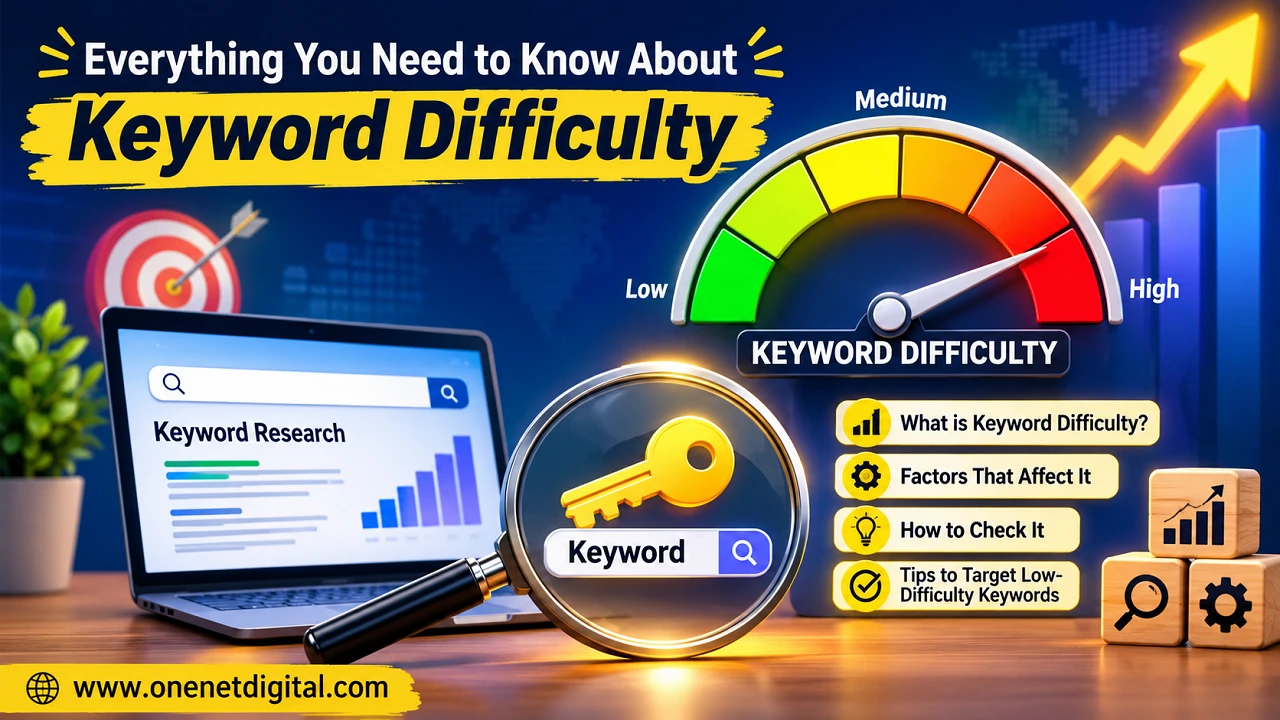
Choosing the right keywords is one of the most important steps in order for your website to show up in the search engine results. Many people just look at the search volume but that does not always mean good results. Some keywords are fiercely competitive while others are much easier to rank for. That’s where knowing the keyword difficulty comes in handy.
Keyword difficulty measures the difficulty of ranking for a particular keyword in search engine results. It helps website owners, bloggers, businesses and marketers to select keywords that match their website strength. This metric can help you save time, plan your SEO strategy better and increase your chances of earning more organic traffic.
What is Keyword Difficulty?
Keyword difficulty is an SEO measurement that indicates the difficulty of ranking for a specific keyword in the first page of search engines. Most SEO tools display the score on a scale of 0-100.
Lower score usually means less competition, which means it’s easier for new websites to rank. A higher score means there are many strong sites competing for that keyword so it may take more time and work to rank.
The primary goal is to assist users in understanding the degree of competition prior to producing content, even though different SEO tools compute this score in different ways.
Why This Metric Is Important
A lot of beginners fall into the trap of going for only the keywords with the highest volume. These keywords can bring in a lot of traffic, but they are also generally very difficult to rank for.
If you check the difficulty score before picking a keyword, you can concentrate on opportunities that are appropriate for your website’s authority. This allows you to set realistic SEO goals, rather than trying to compete head-on with large, well-established websites.
It also helps you plan your content strategy better and use your time on topics that have a better chance of bringing traffic in.
Also Read: Understanding Search Intent: A Practical Guide for Beginners
How to Calculate Difficulty Scores
SEO tools use different ways to calculate the keyword difficulty. Most of them are checking out the websites that are already ranking on the first page of search results.
They might look at things like the number of backlinks, the quality of the backlinks, domain authority, page authority, content quality and the overall strength of the website.
Some tools also analyse search intent and competition level of ranking pages. The scores aren’t always identical, because each tool uses a different formula.
Low, Medium and High Competition Explained
Low difficulty keywords are generally easier to rank for. These are typically long-tail keywords with low competition and are ideal for new websites.
Medium difficulty keywords need good content, proper optimization and some quality backlinks. These offer a balance of search and competition traffic.
High authority popular websites tend to focus on keywords that are difficult. These keywords usually take longer to rank for and demand consistent SEO efforts and a strong backlink profile.
With these levels in mind, you can create a balanced keyword strategy instead of just targeting the most competitive terms.
Factors Affecting Ranking Difficulty
There are a lot of things that make it easier or harder to rank for a keyword. A big factor is how strong the sites that are already ranking on the first page are.
Content quality is also an important factor. Well-written, helpful and updated content has a better chance of ranking higher.
Backlinks from trusted sites make pages more competitive and authoritative. User experience, speed, mobile friendliness, internal linking, and technical SEO all play a role in improving rankings.
Another important factor is the search intent. Your content should give your audience what they are looking for when they search for a keyword.
Also Read: How to Optimize Content for AI Overviews | One Net Digital
How to Pick Better Keywords
Don’t only go after keywords with high search volume. Find the balance between competition and traffic potential.
Long-tail keywords are a good idea in general because they tend to be more specific and have less competition. They do have less searches per month but they get people that are searching for something specific.
Looking at competitor sites can also help you discover keywords you may have missed. Keyword research and useful content are a winning combination for long term SEO success.
Mistakes to Avoid
A common mistake is to completely ignore keyword difficulty. This can lead to the creation of content that has very little chance of ranking.
Another mistake is to depend on one SEO tool. When comparing data from several sources, it is possible to get a better understanding, because different tools calculate scores differently.
The other thing people forget to factor in is search intent. A low competition keyword is not a guarantee that you will rank well, especially if your content does not answer the user’s question.
Another frequent issue is publishing content without regular updates. Most of the time search engines like new and relevant info.
How to Get Long-Term Success with SEO
Keyword difficulty should not be the only part of your SEO strategy. It should be one part of the strategy. Creating useful content, improving website speed, building quality backlinks and providing a good user experience all contribute to improving rankings.
Monitor your keyword performance regularly and refresh older articles as needed. As your website builds authority over time, you can work towards more competitive keywords.
SEO is a marathon, not a sprint, and slow and steady usually wins the race as opposed to going for competitive keywords right out of the gate.
Also Read: How AI Is Changing the Way People Search Online
Final Thoughts
Knowing keyword difficulty helps you make smarter SEO decisions. It helps you pick keywords that match your website’s current strength and increases your chances of ranking in search results.
Don’t just chase popular keywords, concentrate on creating valuable content around keywords that have a realistic chance of ranking. With continuous effort, good optimization and regular content updates, your website can reach a steady growth and gain more and more organic traffic with time.
FAQs
1. What’s a good keyword difficulty score?
It depends on the authority of your website. New sites have a better chance of ranking for lower difficulty keywords.
2. Does a high difficulty score mean I should avoid that keyword?
Sometimes. You can still target high-difficulty keywords, but they take longer to rank, need quality backlinks, and require stronger SEO.
3. What is more important, search volume or keyword difficulty?
Both are significant. The best way is to pick keywords that offer a good balance of search volume and competition.
4. Can a new website rank for competitive keywords?
Yes, but it takes a little more time and a little more effort usually. A better method is to begin with lower competition keywords.
5. Do all SEO tools provide the same difficulty score?
No. Different SEO tools calculate the score in different ways, so the numbers might differ a little.
6. Why are long-tail keywords easier to rank for?
Long-tail keywords are more specific and tend to have less competition, which makes them a good option for newer websites.
7. Should I check keyword difficulty before making content?
Yes. Before you begin creating content, it’s wise to review the competition levels so you can select topics that will rank better.
8. Can keyword difficulty change over time?
yes. As more sites produce content and competition increases, the difficulty score can change.
9. Is keyword difficulty the only thing that matters in SEO?
No. Content quality, backlinks, technical SEO, website speed, user experience, and search intent are also important for better rankings.