
Introduction
Thousands of new blog posts, landing pages and articles are published online every day. The volume of content is increasing, but not all of it is useful to readers. Many pages have information that is already there, answer no real question, or have useless filler just to pad the word count.
Publishing content of no value hardly serves the users or search engines. If visitors don’t find useful information, they may leave the page quickly. Search engines are getting better at recognizing content that lacks originality, depth, or relevance.
Rather than trying to churn out more content, it’s often better to build fewer pages that actually solve problems. A helpful article builds trust, improves user satisfaction and is more likely to do well in search results over time.
What Does “Low-Value Content” Mean?
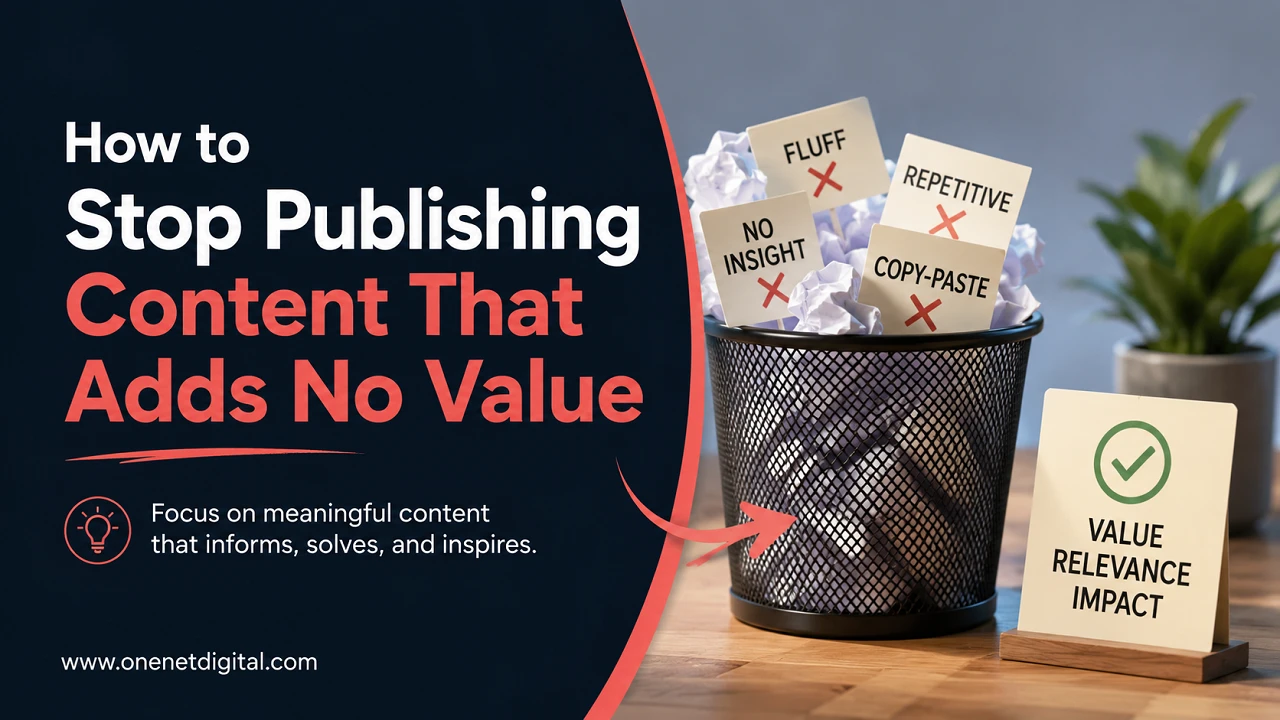
Low-value content means any page that provides little or no meaningful value to the people it is intended for. It often repeats information that’s already on countless websites, covers a topic without answering important questions, or includes unnecessary text that doesn’t help readers. This content might also be aged, too generic or created solely to target search keywords instead of solving real user problems.
Typical examples are articles that just repeat existing content, thin pages with little useful information, outdated guides that no longer apply to current practices and content created by AI that is published without proper editing or fact-checking. The point is not to put out longer articles just to have more words. All content should instead help people learn something useful, solve a problem, or make a better decision.
Start with a Clear Purpose
Before you create any page, ask yourself one very important question: Why should this content exist? If you can’t answer that question clearly, then you may not be providing enough value on this page for your audience.
Each article should cover one main topic and be written to solve a specific problem. Readers should know immediately what they’re getting from reading the page. So instead of talking about a broad topic like SEO in general, it is often more effective to write focused content about how to improve page speed, organize the website structure, or write better meta descriptions. Content that has a clear purpose is easier for the reader to understand and more useful.
Understand What Users Are Looking For
One of the biggest reasons why content performs poorly is because it doesn’t align with what users are actually searching for. People don’t use search engines for fun. They have a goal. They want answers, solutions, comparisons, or directions. If your content doesn’t meet that need, visitors will likely bounce quickly.
Think about your purpose as a reader before you write. Think about the problem they’re trying to solve, the information they’d like to get and any other information that would make the content more useful. The more your article meets user intent, the more valuable it is, the better the overall user experience, and the greater the chance of it succeeding in search results.
Also Read: How to Decide When a Topic Deserves Its Own Page
Avoid Writing Just for Keywords
Keywords are still very important for SEO, but they have to support your content, not take over it. The old favorite technique of optimization was repeating the same keyword again and again. Today search engines place much more emphasis on relevance, quality and the overall usefulness of the content.
Don’t just stuff keywords in every paragraph. Write naturally with the reader in mind. Use related terms where they fit naturally, create descriptive headings, and ensure each section answers an important question. If your content is really good on the subject then keywords will tend to appear naturally without you having to repeat them.
Add Original Insights
There are a lot of articles that don’t stand out because they are just reiterating what is already out there. Readers appreciate content that covers a subject in a new, useful, or easier-to-understand way.
Original insights don’t always mean new research. You can enhance your content with concrete instances, stepwise explanations, common mistakes to avoid, observations on the real world or simple comparisons that make complex ideas easier to understand. You can be more valuable than other pages even if you’re just clarifying and organizing the information that’s already out there.
Keep Information Accurate and Current
Accurate information builds trust and out of date content can confuse readers and damage your website’s credibility. This is especially true for topics that change frequently such as SEO, technology, digital marketing, or software.
Regularly check your content and update stats, industry developments, tools, search engine recommendations, and broken links as needed. Updating old posts is a great way to keep them relevant over time and usually achieves better long-term results than simply adding new posts continuously.
Focus on Readability
Content, no matter how informative it is, can be useless if it is difficult to understand. When a page is easy to read, visitors are more likely to consume the information and stay longer on the page.
Use clear headings, write short paragraphs and break down complicated topics into smaller sections. Keep sentences simple and direct. Avoid unnecessary complexity. Use bullet points only if it clarifies. A good article is structured so that readers can quickly find the information they need, and it also helps search engines understand what the content is about.
Also Read: How to Balance SEO and User Experience in Website Content
Remove Unnecessary Filler
Many authors hold that each article should be a specific number of words long, which results in redundant explanations and superfluous filler. However, longer content is only useful if each part adds something of value.
In the editing process, remove anything that repeats earlier points, does not add to the main topic, or is there just to pad the length of the article. A short article that provides what you need to know in a clear and helpful way is usually a better user experience than a long page that is repetitive or generic.
Support Content with Reliable Sources
For any facts, statistics, research results or important assertions, you should always refer to trustworthy and reliable sources. Good information creates confidence in the reader and makes your content more credible.
For technical subjects or fast-moving industries, fact check before you publish and update references as necessary. Good content is good for your readers and helps make your website a reliable source of information.
Think Beyond Search Rankings
Of course, it is important to be more visible in the searches, but it should never be the focus of content creation. The best page is the one that offers real value to make visitors come back after they have arrived.
Useful content keeps readers longer on your website, makes them click through to related pages, learn something new, and come back to you when they need more information. If you focus on user satisfaction, writing for search engines alone usually gives you better SEO results in the long run.
Review Content Before Publishing
Before you push that publish button on an article, take some time to check it from your readers’ perspective. Be sure the page answers its main question, gives accurate information, and is easy to read from start to finish.
Look for things you can cut, things you say more than once, things that are not clear, or things that could be better organized. A comprehensive final check weeds out errors and ensures each printed page adds actual value for your audience.
Also Read: How to Remove Unnecessary Content from Your Website
Build a Long-Term Content Strategy
Creating good content is not about writing new articles every day. It’s about consistently producing high-quality content that remains useful for a long time. A good content strategy will focus on quality over quantity and put the audience’s needs first.
Structure your content around topics that your readers really care about. Keep your website organized with a logical website structure. Update important pages regularly. In the long run, a substantial amount of informative, relevant, and well-maintained content will deliver much greater long-term value than the publishing of a high volume of low-quality pages.
Conclusion
Publishing content just to fill pages on your website is usually not a great strategy. Readers want information that is clear, accurate, and useful for solving a problem or making a decision.
Knowing what the user is looking for, cutting out the fluff, keeping things accurate, and focusing on original thoughts can help you create content that serves both your audience and the search engines.
The goal is not to publish more content; it is to publish content that really adds value. The more that each page has a clear purpose and provides meaningful information, the more helpful, trustworthy, and well-positioned for long-term SEO success your website becomes.
FAQs
1. What is low-value content?
Low-value content is content that provides little or no useful information to readers. It often repeats existing information, lacks depth, or fails to answer the user’s search intent.
2. Why is low-value content bad for SEO?
Low-value content can reduce user engagement, increase bounce rates, and make it harder for search engines to recognize your website as a reliable source of information.
3. How can I identify low-value content on my website?
Review your pages to see if they answer users’ questions, contain accurate information, offer original insights, and provide enough value. Pages with outdated, thin, or repetitive content should be improved or removed.
4. Should I write content only for keywords?
No. Keywords are important for SEO, but your primary focus should be creating helpful content that satisfies user intent. Use keywords naturally instead of forcing them into every paragraph.
5. What makes content valuable to readers?
Valuable content solves a specific problem, answers important questions, provides accurate information, is easy to read, and offers practical insights or examples that help the audience.