
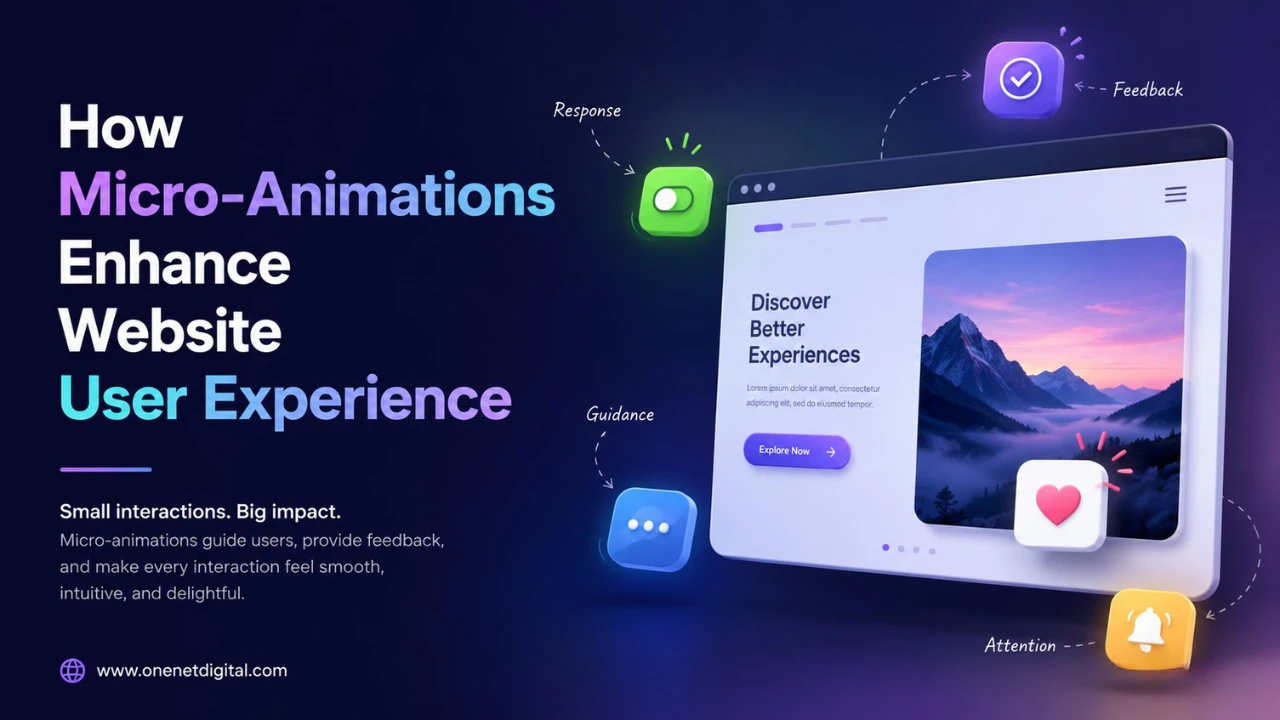
- Introduction
- What Are Micro-Animations and Why Do They Matter?
- Designing Faster & Smarter User Feedback
- Make Website Navigation More Natural
- Small Interactions to Keep Visitors Coming Back
- Reducing User Confusion During Browsing
- Why Micro-Animations Matter for Mobile Users
- Giving Users the Confidence to Take Action
- Motion Design for Brand Personality
- Common Micro-Animation Mistakes Businesses Should Avoid
- The Importance of Micro-Animations in Modern Web Design
- Conclusion
- Frequently Asked Questions
Introduction
In the online world, the experience of the website user has become one of the most important success factors. Visitors in 2026 expect websites to be smooth, responsive, and easy to use. A modern design is no longer enough. What happens when users click a button, move between pages, submit a form, or interact with various other elements on the website?
That’s where micro-animations come in. These subtle visual movements may seem trivial on the surface, but they can add a great deal to the overall experience of browsing. Used correctly, micro-animations help users understand actions, navigate more intuitively, and interact with websites with greater confidence.
Many successful websites use micro-animations, not because they look beautiful, but because they help make the user journey more natural and intuitive. Even slight motion can enhance engagement and help visitors feel more at ease while browsing.
What Are Micro-Animations and Why Do They Matter?
Micro-animations are small visual effects that react to user actions or system changes. They are meant to aid interactions, not to dictate the design.
For example, a button may change color slightly when the user hovers over it, a menu may expand smoothly when it is opened, or a loading indicator may appear while the content is being processed. These little animations convey information without additional text or instruction.
They matter for one simple reason. Users want instant feedback that they are doing the right thing. Micro-animations give that feedback fast and in a way that makes sense visually. They act as a bridge between the users and the website interface, making interactions seem more natural.
Designing Faster & Smarter User Feedback
One of the most valuable functions of micro-animations is feedback. Users click, tap, submit, or interact with something on a website, and they expect a response.
Without visual feedback, users may wonder if the website registered their action. This uncertainty can often lead to frustration, especially when it comes to forms, buttons, or checkout systems.
Micro-animations help solve this problem by instantly showing the user that something has happened. A button animation, a transition for a success message, or a loading indicator can reassure users that the website is responding correctly.
These little visual signals create trust and make for a much smoother feeling during the browsing experience.
Also Read: Why Your Website Homepage is Confusing Visitors
Make Website Navigation More Natural
Navigation is one of the most important elements of any website. Users should always know where they are, where they can go next, and how the different sections relate to each other.
Micro-animations help to make the transition between different sections of a website smoother. Animations take users from one interaction to the next, rather than content popping up out of nowhere. This results in a greater sense of flow and continuity.
Dropdown menus, expandable content sections, and navigation panels, for example, often benefit from smooth opening and closing. These small movements help visitors learn how the structure of the website works.
This means users are more confident in their navigation and less likely to become lost along the way.
Small Interactions to Keep Visitors Coming Back
Small details can influence user engagement. A responsive and interactive website naturally encourages users to spend more time on it.
Micro-animations add a subtle touch of interaction to the website, making it feel more alive. Visual feedback to user actions makes the experience more gratifying and fun.
You don’t want to wow visitors with spectacular effects. Instead, the focus is on the development of a sense of responsiveness that engages users with the interface. Simple hover effects, transitions, or interactive icons can give the website a more polished feel.
Visitors who like to interact with a website are more likely to continue to browse additional pages and engage with more content.
Reducing User Confusion During Browsing
Many websites are losing visitors because users are confused. They may be unsure of which elements are clickable, where to find information, or what actions to take next.
To mitigate this confusion, visual guidance is provided using micro-animations. A slight move might indicate a button is clickable, and a smooth transition might reveal more content in a clear, understandable way.
Websites can use motion to communicate functionality rather than extensive instructions. This helps users learn the interface more quickly and reduces the learning curve.
The easier a website is to understand, the more likely a visitor will stay and complete the tasks they set out to do.
Also Read: How to Make Your Website Feel Human and Personal
Why Micro-Animations Matter for Mobile Users
Mobile traffic continues to dominate website usage, making mobile user experience more important than ever before. Since touch, not mouse movements, control mobile devices, visual feedback becomes even more useful.
When users press a button on a smartphone, they want confirmation that the action was registered. This reassurance is provided instantly by micro-animations.
A better mobile experience is created by smooth transitions between menus, loading indicators, swipe responses, and interactive feedback. It’s these little touches that make mobile websites feel more responsive and trustworthy.
People using smartphones tend to browse quickly, so even small usability improvements can have a big impact on engagement and satisfaction.
Giving Users the Confidence to Take Action
Confidence is a big player in conversion rates, whether users are filling out a contact form, making a purchase, or signing up for a service.
Micro-animations help to build that confidence because each step feels clear and predictable. A kind confirmation as you enter information or a smooth transition from one checkout step to the next reassures users that they are heading in the right direction.
This is especially important on important actions where users may hesitate. Small visual signals reduce uncertainty and make the trip from start to finish smoother.
If users are feeling safe and educated in the process, they’re more likely to follow through with the desired action.
Motion Design for Brand Personality
Every website has its own personality, and micro-animations can help to reinforce that personality. Motion design is not only functional, but can support branding when used intentionally.
A tech company might use clean, crisp animations to communicate innovation and professionalism. For example, a creative business may use a bit more expressive movement that matches the art style of the business.
Consistency is the key. Animations should be consistent with the overall design language and support the brand experience, not detract from it.
When all the visuals are in harmony, the website is more cohesive and memorable, which helps visitors establish stronger associations with the brand.
Also Read: Why Most Companies Use Too Many Plugins on Their Website
Common Micro-Animation Mistakes Businesses Should Avoid
Micro-animations have many advantages, but when overused, they can cause problems. Some businesses add too many motion effects because they think the more animation, the better the user experience.
In fact, too much movement can be a distraction to visitors and can give a cluttered feeling to the website. Big animations, constant motion, and pointless transitions can slow interaction down rather than improve it.
The best micro-animations are purposeful and subtle. Every animation should have a purpose: to provide feedback, to direct attention, or to make navigation easier.
Good animations are those that improve usability rather than compete with it, and they’re a valuable part of the user experience.
The Importance of Micro-Animations in Modern Web Design
Web design is evolving into the creation of seamless, natural experiences. With user expectations on the rise, businesses are paying more attention to the finer details that impact engagement and usability.
Micro-animations are a key part of this approach and help improve communication between users and interfaces. They help websites feel professional, responsive, and easy to comprehend.
As websites evolve, such subtle interaction improvements will likely become even more common. Companies doing user-centered design are already seeing the benefit of motion as a tool to boost digital experiences.
Conclusion
Micro-animations may be tiny design elements, but they can have a huge impact on website user experience. They are used to provide feedback, to improve navigation, to reduce confusion, and to promote engagement, making for more natural and seamless interactions.
By 2026, users will expect that websites will be responsive and easy to use. By investing in good micro-animation design, businesses can make their experiences more polished and user-friendly without overwhelming visitors.
Often the best micro-animations are the ones users don’t even notice. They work behind the scenes, so every single interaction is natural and seamless. When done right, these little things can add up to more engagement, better usability, and an overall improved experience on your site.
Frequently Asked Questions
1. What are micro-animations in website design?
Micro-animations are small visual effects that help to improve user interaction on a website.
2. What are the benefits of micro-animations in website user experience?
They make navigation easier, they provide instant feedback, they reduce confusion, and they help users interact with the elements of a website with more ease.
3. Do micro-animations boost engagement on websites?
Yes, some subtle micro-animations can make the website more interactive and make visitors spend more time browsing.
4. Can micro-animations improve conversion rates?
Used properly, micro-animations can help guide user actions, improve usability, and help increase conversions.
5. Are micro-animations important for mobile sites?
Yes, they improve mobile usability by providing users with clear visual feedback when they tap, scroll, and navigate.
6. Are micro animations impacting website speed?
Well-optimized micro-animations don’t affect speed much, but too many animations slow down website performance.
7. Do micro-animations help with SEO?
They don’t directly affect SEO rankings, but they can help improve user experience and engagement, which may lead to better SEO performance.