
Introduction
One blog post is no longer sufficient to create long-term visibility in the search engines. Today you need to write more than one article on a topic, you need to cover it from different angles. That’s where supporting content comes in. Instead of random posts you make several articles that are linked to one main topic. This helps readers to find more valuable information and also tells search engines that your website has strong knowledge on the subject.
Supporting content isn’t just a copy of the same ideas. Each article must address a question, solve a problem, or explain a particular aspect of the main topic. If you link these articles to each other with internal links, you create a well-structured content organization that is easier to understand for users and search engines.
Choose a Powerful Main Subject First
It all starts with the correct main topic. It should be broad enough to fit a few related articles, but specific enough to match the purpose of your website. For instance, if your website is about digital marketing, broad topics could be “Email Marketing” or “SEO Basics.” Naturally, these topics have many smaller areas that deserve their own detailed articles.
Before you begin to write, consider what your audience wants to know. Consider someone looking for information on your topic. What would be their first question? What did they want to know, anyway? This way of thinking lets you create a complete content plan instead of random blog posts.
Your content strategy is based on a strong main topic, with all supporting articles helping to explain different parts of it.
Associated Questions and Subtopics
Finding supporting ideas is the next step after choosing the main topic. Don’t guess. Find the questions people are really asking. Useful inspiration can be found in search engines, online forums, community discussions and keyword research tools.
Think out of the box. Readers usually look for comparisons, step-by-step guides, beginner tips, common mistakes, advanced strategies, and real-life examples. Each of these can be a separate article that supports your main page.
For instance, if the main topic is “Content Marketing,” supporting articles might cover content planning, content calendars, writing techniques, content promotion, performance tracking, and common challenges. Each article brings value without repeating the same thing over and over.
Also Read: Why Semantic SEO Is More Important Than Exact Match Keywords
Develop Content with a Defined Goal
Each supporting article should have a purpose. You can write an article to teach beginners, another to explain advanced concepts, and another to solve a common problem. When each page has a specific purpose, visitors spend more time exploring your website.
Avoid creating several articles that answer exactly the same question. Similarly, pages are competing with similar pages for search results, making it difficult for search engines to decide which page deserves a better rank.
Choose a different perspective to give each article its own unique spin. This helps keep your website organised and prevents unnecessary duplication.
Good supporting content also has long-term value. Skip the trending articles and add some evergreen articles that will continue to help your readers months or even years after it has been published.
Use Internal Links to Connect Articles
Internal linking is one of the most critical elements of a supporting content strategy. When you publish related articles, link them in naturally within the content. When they finish reading an article, they should be able to find another page that explains the next step or a related concept easily.
For example, a person reading about keyword research might also benefit from reading articles about search intent, content optimisation, or on-page SEO. Connecting these pages provides a logical learning path.
Search engines also use internal links to understand how pages are related. A well-connected site provides more authority to important pages, and allows search engines to crawl new content more easily.
Keep internal links relevant and natural. Too many unnecessary links can confuse readers rather than help them.
Create Topic Clusters for Your Content
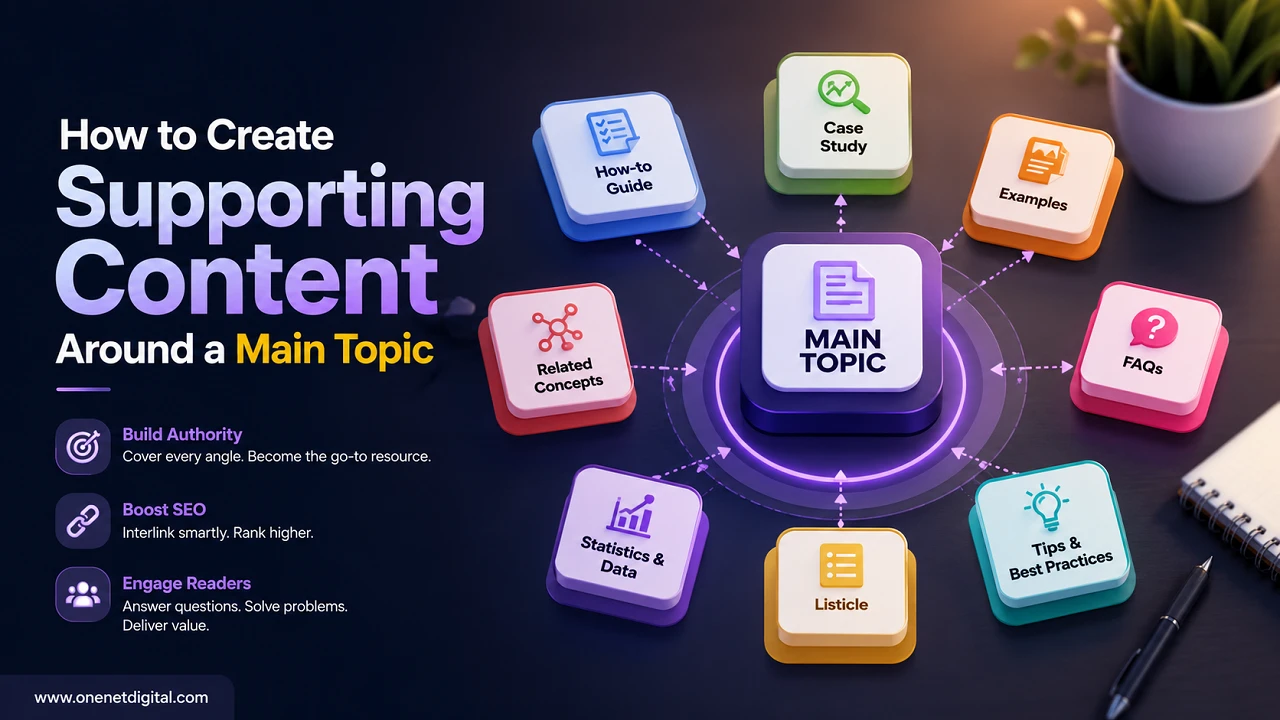
A topic cluster is just a group of related articles that link to one main page. The main page provides a full overview, and supporting articles provide more depth in each section.
This framework guides your visitors from broad concepts to more specific explanations without having to leave your site. It also makes it easier to organise your content, since everything on a topic is all in one place.
Rather than writing blog posts every week in isolation, consider each new article as another piece in a bigger knowledge library. Your website no longer continues to be a collection of separate pages and has become a resource that people trust over time.
Topic clusters also make future content planning simple, as you can instantly see what’s already been covered and what’s still left to cover.
Also Read: How to Look for Questions Google Would Like You to Reply
Update the Supporting Content
Publishing content is just the start. Information changes over time, new trends appear, user questions change. Supporting articles are constantly updated to ensure they are accurate and useful.
Review old content every few months. Whenever you publish new articles, add new examples, improve explanations, replace old information, and update internal links. Small changes that can keep content relevant without re-writing everything from scratch.
Updated content also improves the experience for visitors because they get current information instead of advice that is outdated. These improvements are often also recognised by search engines which can have a positive effect on visibility.
Better to be consistent than to keep on writing new articles and forgetting the old articles.
Measure Performance and Expand Slowly
Create your supporting content, then watch how it performs. Look at page views, average time spent reading, search rankings, internal link clicks and user engagement. These insights reveal which articles are attracting visitors, and which ones may need to be improved.
If one supporting article does particularly well, think about writing more articles related to that one area. That means your content strategy can grow organically from actual audience interest, not assumptions.
Content building should be a never-ending task. Publishing dozens of articles all at once is not the way to go. Consistent addition of high-quality supporting content is. With time, your website will be able to build better topical coverage, which will help the readers find the most valuable information and boost your SEO efforts.
Also Read: How to Decide Whether a Keyword Is Worth Targeting
Conclusion
It’s smart to build supporting content around one main topic so that you can build an organised and helpful website. Instead of publishing off-topic articles, concentrate on building a comprehensive set of content that addresses different questions on the same topic. Choose a strong main topic, research useful subtopics, write unique articles, link them internally, and keep everything updated over time. This improves user satisfaction, gives your website more authority and creates a content structure that will continue to provide value in the long term.
FAQs
1. What is supportive content in SEO?
Supporting content are articles related that explain different aspects of a main topic. Together these pages give full information and improve the overall structure of a website.
2. What is the importance of supporting content?
Supporting content helps readers to find more relevant information, increases time on site, improves internal linking and increases topical authority for better search engine rankings.
3. How many supporting articles should a main topic have?
There’s no set number. For a single subject, you might have five articles, or ten or twenty supporting articles, depending on the subject and what your audience needs.
4. What is a cluster of topics?
A topic cluster is a group of related articles that are linked to one page. The main page gives an overview of the subject, with supporting articles describing specific areas in more detail.
5. Should supporting articles considered different keywords?
Yes, each supporting article should tackle a different keyword or search intent so that the content is not repetitive and has a better chance of ranking for different relevant searches.
6. How often should you update supporting content?
Review the supporting content every few months or when there is a change to important information. Regular updates keep things accurate, give a better user experience and remain relevant to search engines.