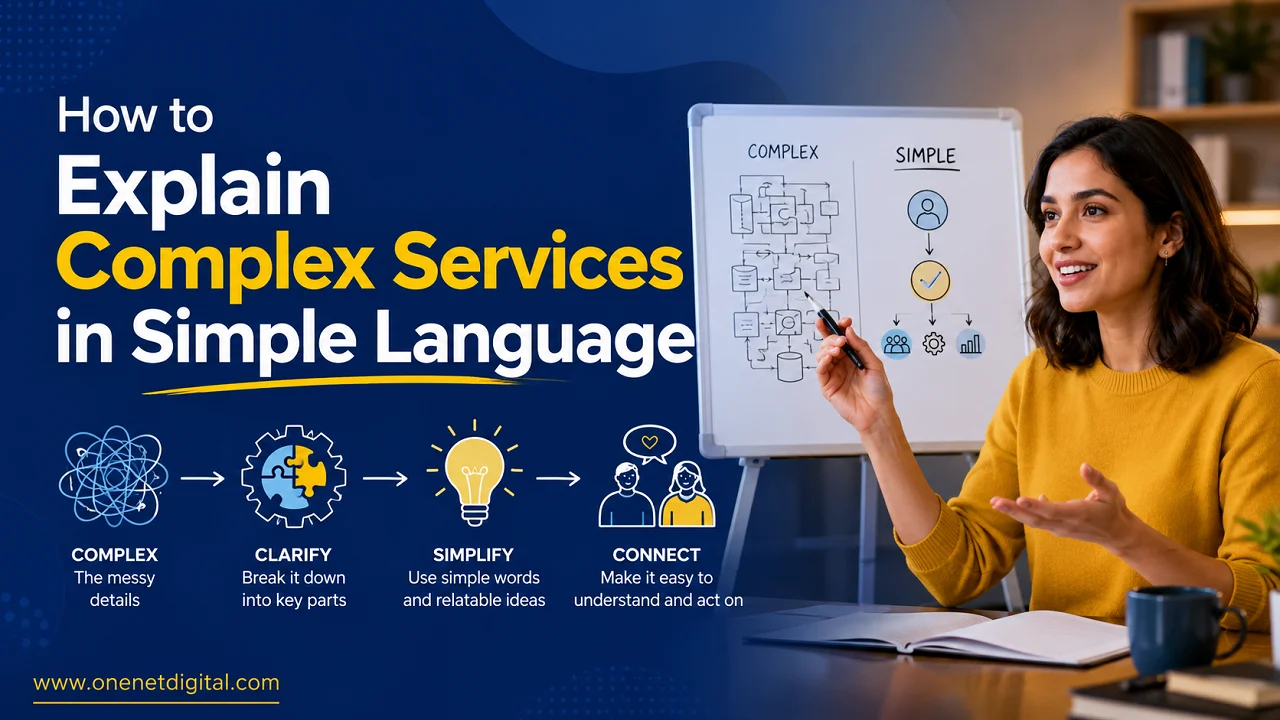
There are a lot of companies with services that are hard for their customers to understand. Industries such as digital marketing, software development, finance, healthcare, legal services and technology use technical jargon that can confuse potential clients. If people don’t know what a business does, they’re less inclined to ask questions or buy services.
Simple language is a critical element in explaining complex services clearly. Customers like to see clear information about how a service can solve their problems. When businesses communicate clearly, customers tend to trust them more quickly and have a better experience.
In today’s competitive online environment, simplicity is not just a writing style. It’s a business advantage.
Why Simple Language Matters
Most customers are not industry experts and can be confused by technical terms and complicated explanations. A confusing website or marketing message will have people leaving without taking any action.
Plain language helps businesses to be understood by customers better, build trust, increase engagement, provide a better user experience and improve conversion rates. When a service’s offering is clear, people are more likely to make decisions.
Start by Understanding Your Audience
You must understand who your audience is before you simplify your services. Different customers have different knowledge and may not understand the industry language.
Ask yourself: Who is consuming your content? What problems are they trying to solve? What questions might they have? Speaking the same language as your audience makes it easier to explain your services.
Focus on the Problem You Solve
Too many businesses spend too much time explaining the technical process, not enough time on the results. Customers generally care more about what a service can do for them than how it works.
Explain the outcome, rather than using complex descriptions. For example, you could say “We help businesses generate more online enquiries and sales” instead of technical marketing jargon.
Avoid Industry Jargon
All industries have their own technical terms that may be understandable internally but confusing to the customer. Too much jargon can create communication barriers and make services seem complicated.
Substitute technical words with simple words. Simple and clear words help your services be more relatable and easier to understand.
Also Read: How to Create Website Content People Actually Read
Use Everyday Examples
People tend to understand difficult concepts faster with examples and comparisons. Services that are relevant to everyday situations help make abstract ideas more memorable.
For example, cloud storage can be described as a locker online that allows files to be stored and accessed from any device. Complex topics are easier to explain with simple comparisons.
Break Information into Smaller Sections
Readers can be overwhelmed by large amounts of information. Divide content into small chunks, it makes it easier to read and helps people understand information step by step.
What the service is, why it’s important, how it benefits customers, and what outcomes they can anticipate. This structure helps keep the information simple and organized.
Use Short and Clear Sentences
Long sentences filled with technical words often get lost on readers. Short, simple sentences are more readable and understandable.
Do not use complicated language. Explain ideas in a straightforward way. Simple sentences increase clarity and allow readers to quickly process information.
Explain Features Through Benefits
Benefits are normally of more interest to customers than features. Don’t just list technical features. Explain how those features help solve problems or make life easier.
For example, instead of just saying “24/7 support”, explain that customers can get help any time they need it. Linking features to benefits makes services more meaningful.
Also Read: How to Make Your Website More Search-Friendly
Answer Common Questions
Often, potential customers have similar questions before making a decision. They want to know what the service does, how it works, and what results to expect.
Simple answers to common questions help to remove confusion and make your services easier to understand. FAQs are particularly helpful because they provide information in a simple and conversational format.
Use Visual Language
Descriptive language makes it easier for people to imagine concepts. Comparing a service to something familiar helps create a mental image that makes it easier to understand.
For example, it is easier to explain that a system consolidates all messages into one inbox than to use technical terms related to communication channels.
Remove Unnecessary Details
Customers do not usually need to know all the technical details of a process. If you give too much information, it can be hard to follow an explanation and cause confusion.
Concentrate on the most important information. Talk about the service, and what it will do for the customer. Leave the technical stuff to those that want it.
Test Your Content with Non-Experts
A good way to gauge clarity of content is to have it read by someone outside of your industry. If they easily understand what you do and why it matters, your message is probably clear.
If they have difficulty understanding the explanation, make the language even simpler. Testing with non-experts can often point out areas for improvement.
Also Read: How to Improve Search Rankings Without Publishing Every Day
Keep Customer Language in Mind
Businesses and customers often talk about problems in different ways. Companies speak in technical terms. Customers use simple, everyday language.
When you use the same words that your customers use, your content becomes more relatable and easier to understand. Hearing customer questions, reviews and feedback can teach you to communicate better and build trust.
Conclusion
Explaining complex services in simple language is a crucial skill for today’s businesses. Customers want to know how a service solves their problem. They want things to be simple and clear.
Simple communication does not mean dumbing down expertise or oversimplifying important details. Instead, it is communicating information in a way that is easily digestible and relevant to the customer.
Making complex services easier to explain to businesses requires understanding the audience, not using jargon, using examples, focusing on benefits, organizing information in a clear way and using everyday language.
The faster you can communicate what you do and how you can help people, the more likely they are to trust, ask questions and take the next step. One of the most powerful tools to nurture better customer relationships and enhance online business growth is clear communication.
FAQs
1. Why is simple language important when explaining services?
Simple language helps customers understand your services quickly, builds trust, and makes it easier for them to make informed decisions.
2. Why do customers struggle to understand complex services?
Many customers are not experts in a particular industry and may not understand technical terms, jargon, or complicated explanations.
3. How can businesses identify their target audience?
Businesses can understand their audience by researching customer needs, pain points, knowledge levels, and the common questions they ask.
4. Should businesses focus on features or benefits?
Businesses should focus more on benefits because customers want to know how a service will solve their problems and improve their situation.
5. What is industry jargon?
Industry jargon refers to technical words and phrases commonly used within a profession but often difficult for customers to understand.